It should have been the easiest order imaginable.
A customer walks up to the counter and asks for the “number one hot dog.” There are no complicated instructions, special toppings, or unusual requests that could confuse an employee. He simply wants one hot dog from the menu.
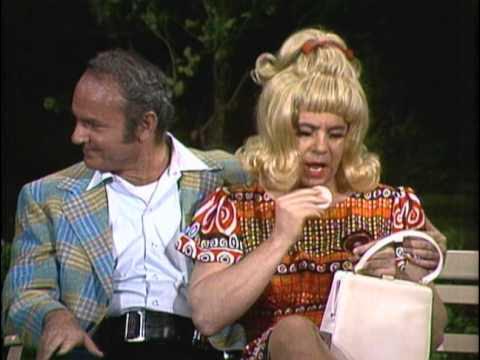
But the man behind the counter is Tim Conway—and in his hands, that ordinary request suddenly becomes one of the most difficult challenges a human being has ever faced.
With his wild, uncombed hair, stained apron, painfully slow movements, and completely serious expression, Conway stares across the counter as though the customer has presented him with an impossible mystery. He shows no sense of urgency. He does not immediately reach for the food. In fact, he barely seems to understand that a transaction is taking place.
Instead, he pauses.
Then he pauses again.
The customer waits.
The audience begins to laugh.
Conway’s character seems to process every word separately, struggling to understand how “number one” connects to “hot dog.” His eyes wander around the counter as though the answer might be hidden somewhere nearby. His body moves at half the speed of everyone else, and each small action appears to demand an enormous amount of thought and physical effort.
The longer the customer waits, the funnier the scene becomes.
That was the magic of Tim Conway.
He understood that comedy did not always require a clever punchline, an outrageous costume, or an elaborate setup. Sometimes, the funniest choice a performer could make was simply refusing to move at the speed the audience expected.
In Conway’s hands, silence became part of the joke. Confusion became a complete performance. A carefully timed pause could create more tension—and more laughter—than an entire page of dialogue.
The hot dog order is funny not because the request is strange, but because Conway treats it as though it is nearly impossible to understand. His character’s complete seriousness makes the situation even better. He never smiles at the audience or signals that a joke is coming. He remains fully trapped inside the character’s slow, bewildered world.
That commitment is what makes the moment work.
A less disciplined comedian might have rushed toward the punchline. Another performer might have exaggerated the confusion through loud dialogue, frantic movements, or obvious reactions. Conway does the opposite. He slows everything down until the audience can almost feel the customer’s frustration growing.
Each second becomes more uncomfortable.
Each uncomfortable second becomes funnier.
By the time Conway finally appears ready to respond, the audience is already laughing at the possibility that he may misunderstand the order all over again.
It is a perfect example of how he could control a room while appearing to do almost nothing.
Conway’s comedic style was built on precision disguised as chaos. His characters frequently looked confused, clumsy, elderly, exhausted, or completely unprepared for whatever was happening around them. Yet the performances themselves were carefully controlled. He knew exactly how long to hold a stare, when to move one hand, when to look away, and when to allow silence to carry the scene.
That kind of timing does not happen by accident.
A pause that ends one second too early may fail to earn a laugh. A pause that continues one second too long may cause the audience to lose interest. Conway somehow understood the exact moment when ordinary waiting stopped being uncomfortable and became hilarious.
In the hot dog scene, he transforms the counter into a stage and makes the customer’s patience part of the joke. The customer wants the transaction to move forward, but Conway refuses to let normal time exist. His character seems to operate according to an entirely different clock.
The audience knows exactly what should happen next. The employee should acknowledge the order, prepare the food, accept the payment, and move on to the next customer.
Conway knows that too.
His comedy comes from delaying every expected action.
The stained apron and messy hair help establish the character before he even speaks. This is not a polished employee prepared to serve lunch quickly and efficiently. He looks like a man who might have spent years standing behind that counter without ever completely understanding how it works.
But the costume alone is not the joke. Conway’s face completes the character.
His expression is not intentionally silly. It is deeply concerned.
He looks as though he sincerely wants to understand the order but simply cannot find the mental energy required to do so. That small emotional detail makes the character strangely believable. Nearly everyone has encountered someone who moves too slowly, misunderstands an obvious question, or somehow turns a routine task into a complicated ordeal.
Conway takes that familiar frustration and pushes it just far enough to make the situation unforgettable.
The scene also reveals something important about the comedy of an earlier era of television. There are no rapid cuts designed to manufacture energy. There are no sound effects instructing viewers when they should laugh. There is no frantic editing attempting to hide weak material.
The camera simply gives Conway enough room and time to perform.
The humor comes from the actor, the character, the situation, and the audience’s growing anticipation.
Modern comedy often moves quickly because creators worry that viewers may lose interest. Jokes arrive one after another. Scenes are divided into smaller pieces, and pauses are frequently removed. Silence is sometimes treated like wasted space that needs to be filled.
Conway understood that silence was never truly empty.
Silence could contain confusion, frustration, expectation, and surprise. It gave viewers time to recognize what was happening, notice the smallest details, and imagine what might happen next. Instead of weakening the joke, the waiting allowed the humor to grow.
The nearly twenty seconds of confusion surrounding a single hot dog order might appear painfully slow when described on paper. On screen, however, every passing second adds another layer to the joke.
The customer’s request remains perfectly simple.
Conway’s response becomes increasingly impossible.
And because he never abandons the character’s seriousness, the audience continues laughing.
That was his special gift. He could say almost nothing, move at half speed, and still command the entire stage. Even when he was surrounded by talented performers, Conway could pull the audience’s attention toward the smallest movement, the quietest reaction, or the slightest change in his expression.
Sometimes, his fellow performers struggled to remain in character because they knew he might change a line, extend a pause, or introduce an unexpected gesture. Part of the excitement came from watching everyone around him attempt to survive the scene without breaking into laughter.
Yet Conway rarely appeared to be fighting for attention.
He simply remained committed to the character until that character became impossible to ignore.
That is why moments such as the hot dog order remain so enjoyable years later. The humor does not depend on a current trend, a political reference, or detailed knowledge of a particular celebrity. It comes from something universal: the agony of waiting while another person fails to understand an extremely simple request.
Almost anyone can recognize that situation.
Only Tim Conway could stretch it into comedy gold.
The scene reminds viewers that great comedy does not have to be loud. It does not need to explain itself, and it does not require a constant stream of dialogue. When the performer understands timing, character, and audience expectations, even the most ordinary situation can become unforgettable.
Sometimes, all a great comedy scene needs is a customer asking for the number one hot dog—and a confused man behind the counter staring back as though the fate of the world depends on his answer.
Tim Conway made audiences laugh by slowing everything down and allowing every awkward second to breathe.
And somehow, beneath that wild hair and stained apron, with almost no dialogue and the most serious expression imaginable, he turned a basic lunch order into a moment television fans would never forget.